top menu

Canvas LMS Classrooms


Educational Classrooms Constructed Using the Canvas LMS Platform

In 2020 I constructed four online course classrooms for the Department of Digital Arts and Design at New York Institute of Technology, NY, NY.  Between 2006-2011, I directed their ‘Program in Fine Arts and Computer Graphics’ on their Amman, Jordan, and Manama, Bahrain campuses. I instructed courses using Adobe Creative Suite supporting student projects in web design and print graphics.  Previously at a university in Indiana I’d created and instructed new courses in a Western Art History three-courses sequence, and Asian Art.  This experience prepared me for a Fulbright teaching scholar grant to instruct ‘Web Design and Social Media’ at KPI polytechnic in Kyiv, Ukraine. I created a website construction tutorial on the WordPress platform which students employed in building personal websites.

This experience was melded into the construction of the four Canvas platform classrooms for NYIT-NY in 2020-2025. As a sample of these classrooms I’ve posted screenshots of the courses home pages, and attached each course syllabus. The quality of student learning improved each semester after I customized the courses structure and content to better match the unique dynamics present in a synchronous and asynchronous instruction. The Canvas LMS platform has similarities to the WordPress platform so my skills in that environment transferred nicely.  I look forward to building Canvas classrooms in the future.

– Lon Kaufmann

X
X
X
X
X
X
X
ARTH151_AH2_F04-Sp25_syllabus-v1.3.25

1.) Art History II- ARTH-151

Art History II follows the Western Art history survey sequence typically covered in three courses. This course follows the classic text by Helen Gardner, ‘Art Through the Ages’. As second in the sequence, it spans the period from Europe’s Late Gothic, through 1945 in Europe and the USA. The assigned research paper applies formal analysis and historical context to compile a paper that reveals the combined aesthetic and conceptual intentions of the artist.

X
X
X
X
X
X
X

ARTH_201_AH3_LKaufmann-F2023_v1.2-102323

2.) Art History III- ARTH-201Art History III is a survey history of Western Art after 1945, from Abstract Expressionism through Contemporary Art, and into the Digital Age. The semester’s research explores the theme of ‘Styles Ancestry’. Throughout history artists, just like scientists, have imagined and invented by ‘standing on the shoulders’ of those who preceeded them. Beginning with a post 1945 artist, students identify their unique stylistic characteristic, and search for the artist’s identification of the artists who inspired them. An examination of the previous influencers artwork reveals specific style elements that show an ancestral link with the post-1945 artist.
X
X
X
X
X
X
X

ARTH602-Aesth-Theory_F23-Syllabus_LKaufmann-v2-102423

3.) Aesthetics and Theory – ARTH-602

Aesthetics and Theory focuses on the philosophical questions surrounding the creative act of image-making, performance art, and interactive artistic experiences. Topics include theoretical outlines that examine the mimetic, expressive, and formalistic categories of the plastic arts. Readings include critical essays and historical perspectives of art theory.

X
X
X
X
X
X
X

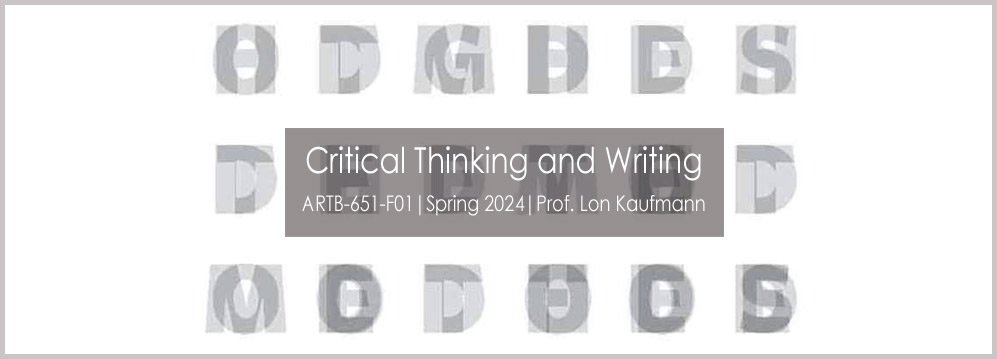
ARTB-651-Critical-Thinking-Writing_LKaufmann-Sp24-v.1-124

4.) Critical Thinking and Writing – ARTB-651

Critical Thinking and Writing about the Arts prepares the student in developing the skills necessary to communicate her/his aesthetic concepts in a formal written paper. The ability to concretely state one’s views in a clear and concise manner is an asset when analyzing the complexity of one’s subjective realm. Assignments include exercises that focus on critical thinking, appropriate vocabulary, meaning, definitions, clarity and objective perspective.

No comments yet.

Leave a Reply